
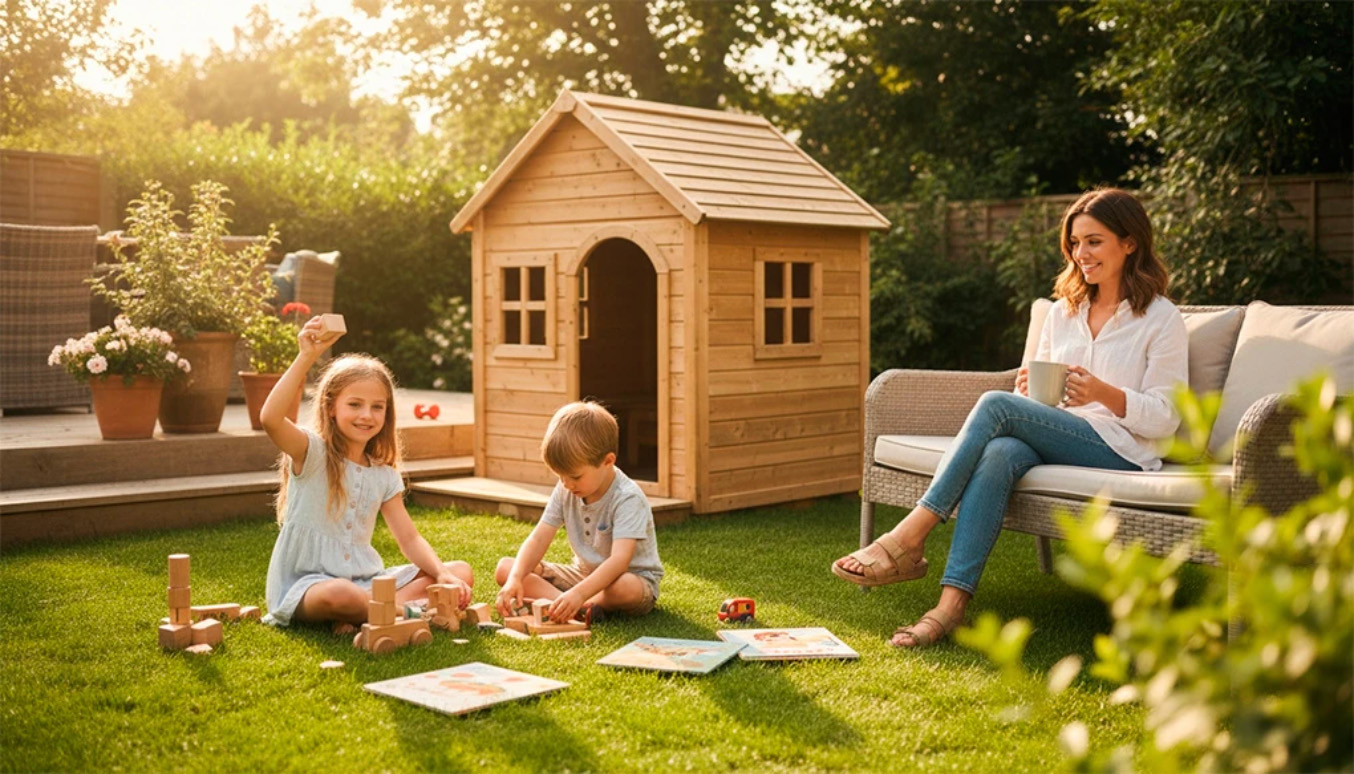
“How a Wooden Garden House Can Create a Safe, Calming Garden Space for Children and Parents” is a collaborative post.
If you have children, you probably know the mixed feelings that come with garden time. Kids want to be outside; you’re trying to juggle meals, laundry, emails and the hope of a quiet cup of tea. Toys migrate across the whole lawn, the weather changes every ten minutes, and you end up hovering by the back door trying to supervise everything at once.
What many families really need is a garden that works more like an extra room: a safe, defined space where children can play freely and parents can actually sit down. A wooden garden house can become the heart of that space – a playhouse, family hub and quiet retreat all in one.
Why Outdoor Play Matters for Children’s Wellbeing
Most parents see the difference in their children after a proper spell outdoors. Time in the garden naturally brings:
- More movement – running, jumping, climbing and balancing in ways that are hard to recreate indoors.
- Less screen time – it’s easier to say “let’s go out to the garden” when there’s an inviting den or mini “home” waiting.
- Richer pretend play – a simple wooden house becomes a café, shop, pirate ship or secret base in imaginary games.
All of this supports emotional balance as much as physical health. Children who’ve had space to burn off energy and immerse themselves in make‑believe often:
- come back inside calmer and more settled;
- sleep better after full, active days;
- argue less, because there’s more room and more options for play.
The question is how to offer that freedom in a real family garden, where safety and supervision still matter.
The Challenge: Safe, Supervised Play in a Real Garden
Very few gardens are designed around children from the start. You might have:
- steps or uneven paving;
- bikes, barbecues, tools or garden chemicals in the same area as toys;
- flowerbeds or pots that don’t mix well with footballs and scooters.
And you can’t be in the middle of the lawn all afternoon. Life continues: cooking, chores, messages, work. You need to be able to glance up and know your child is okay.
Creating a clearly defined children’s zone helps enormously. When there’s a specific corner that says “this is where we play”:
- you can concentrate safety measures in that area;
- children understand their boundaries more easily;
- supervision becomes a quick look out of the window, not constant hovering.
A wooden garden house makes that zone feel like a real destination, not just “the bit of grass with toys on it”.
How a Wooden Garden House Becomes a Playhouse and Family Hub
Think of a wooden garden house as a small, flexible room in your garden. Compared with a plastic playhouse or a storage shed, it offers:
- Shelter – shade in summer, a dry spot in drizzle, and a cosy corner in spring and autumn.
- Clear boundaries – four walls and a door create an “inside” that children instinctively treat as their place.
- Room to grow – from soft mats and picture books for toddlers to a “clubhouse” for school‑age children and their friends.
Positioned so you can see it easily from the kitchen or patio, it lets children feel independent while you still have a clear line of sight.
Natural timber also suits parents who care about aesthetics. Wood feels warm, blends with plants and trees, and avoids the bright plastic look that can make outdoor spaces feel cluttered or overstimulating.
Over time, a well‑chosen structure can move with your family – starting as a playhouse, then becoming a homework nook, music practice room or teen den.
Designing a Child‑Friendly and Parent‑Friendly Garden House
The best family garden houses are planned for everyone’s needs, not just the kids’.
Inside for Children
Simple choices make a big difference:
- Soft flooring – a rug or carpet tiles so play is comfortable even in socks or bare feet.
- Low shelves and baskets – toys, art materials and books within reach, with easy “throw it in the basket” tidying.
- Activity zones – a reading corner with cushions, a small table for crafts, and open floor space for building or role play.
Keeping decor flexible means the space can adapt as children grow.
Comfort for Parents
You’re allowed to enjoy the garden house too:
- Add a comfortable chair or bench where you can sit with a drink while children play.
- Include a side table for a book, journal or laptop during quieter moments.
- Plan soft lighting – a warm lamp or fairy lights – so the space works as a cosy adult retreat once toys are packed away.
When you’re choosing a structure, it helps to think long‑term. A solid timber building can start life as a toddler playhouse, then evolve into a shared study or hangout as your children grow. Brands like Woodera offer purpose‑designed wooden garden houses for families in England that are robust and insulated enough to feel like a true extra room, not just a flimsy summer hut.
If you see the whole garden as a long‑term family project, it can also be useful to look at broader options fornatural wooden outdoor family spaces in the UK. Understanding how playhouses, larger garden rooms and other timber structures work together can help you position the first house so it fits into a future‑proof family garden plan.
Safety Basics
Inside and around the house:
- Choose sturdy furniture and secure taller pieces to the wall.
- Avoid sharp corners where possible.
- Make sure there is simple ventilation so it stays fresh in warmer weather.
Making the Garden Around the House Safe and Soothing
What happens just outside the door is just as important as what’s inside.
Practical Safety
- Create a flat, non‑slip surface at the entrance – decking with grip, outdoor matting or level paving.
- Keep tools, barbecues, cables and chemicals out of the children’s zone.
- If you have ponds, steep drops or areas you’d rather children didn’t explore alone, use low fences, trellis or raised beds to mark clear boundaries.
You don’t need to turn the garden into a playground; thoughtful layout is often enough.
A Calming Atmosphere
To keep the space soothing rather than overstimulating:
- Use soft, natural colours on the exterior and nearby furniture.
- Choose child‑safe plants and mix in herbs or scented plants that children can safely touch and smell.
- Think about shade – a nearby tree, shade sail or pergola – so children can play comfortably even on bright days.
The aim is a garden corner that feels gentle on everyone’s nervous system, including yours.
How a Garden House Supports Parental Wellbeing Too
It’s easy for home improvements to focus entirely on children, but a garden house can quietly support parents as well.
For many mums and dads, especially those spending long stretches at home, this kind of space offers:
- A sense of order – outdoor clutter has a home, instead of spreading across every room and flowerbed.
- The chance to rest nearby – you can sit, read or simply breathe while your child plays a few steps away.
- An easy switch to “adult mode” in the evening – dim lights, a blanket and a book after bedtime.
Emotionally, that can reduce the constant low‑level stress that comes with trying to be “on” all the time. Instead of relying on screens to keep children occupied, you’ve created a corner of the garden that genuinely supports the whole family’s wellbeing.
Simple Rules to Keep the Space Safe and Enjoyable
A few light‑touch rules help the garden house stay a positive place:
- Check the structure regularly – floor, steps, roof, windows and door catches.
- Store tools and chemicals elsewhere – keep this building firmly in the “play and relax” category.
- Agree “house rules” with children – no climbing on the roof, no rough play near windows, and a quick tidy before going back indoors.
Involving children in looking after “their house” can build pride and responsibility as well as keeping everyone safer.
Final Thoughts: A Small House That Changes Daily Life
A wooden garden house might look like a simple addition, but it can quietly reshape day‑to‑day family life. It gives children a safe, special place to play and imagine; it brings more calm and order to the garden; and it offers parents a peaceful corner to sit, watch and exhale.
Even a modest, carefully planned structure can turn your outdoor space from “another thing to manage” into a genuine family sanctuary – one that supports both children’s need to explore and your own need to rest.






Comments are closed.