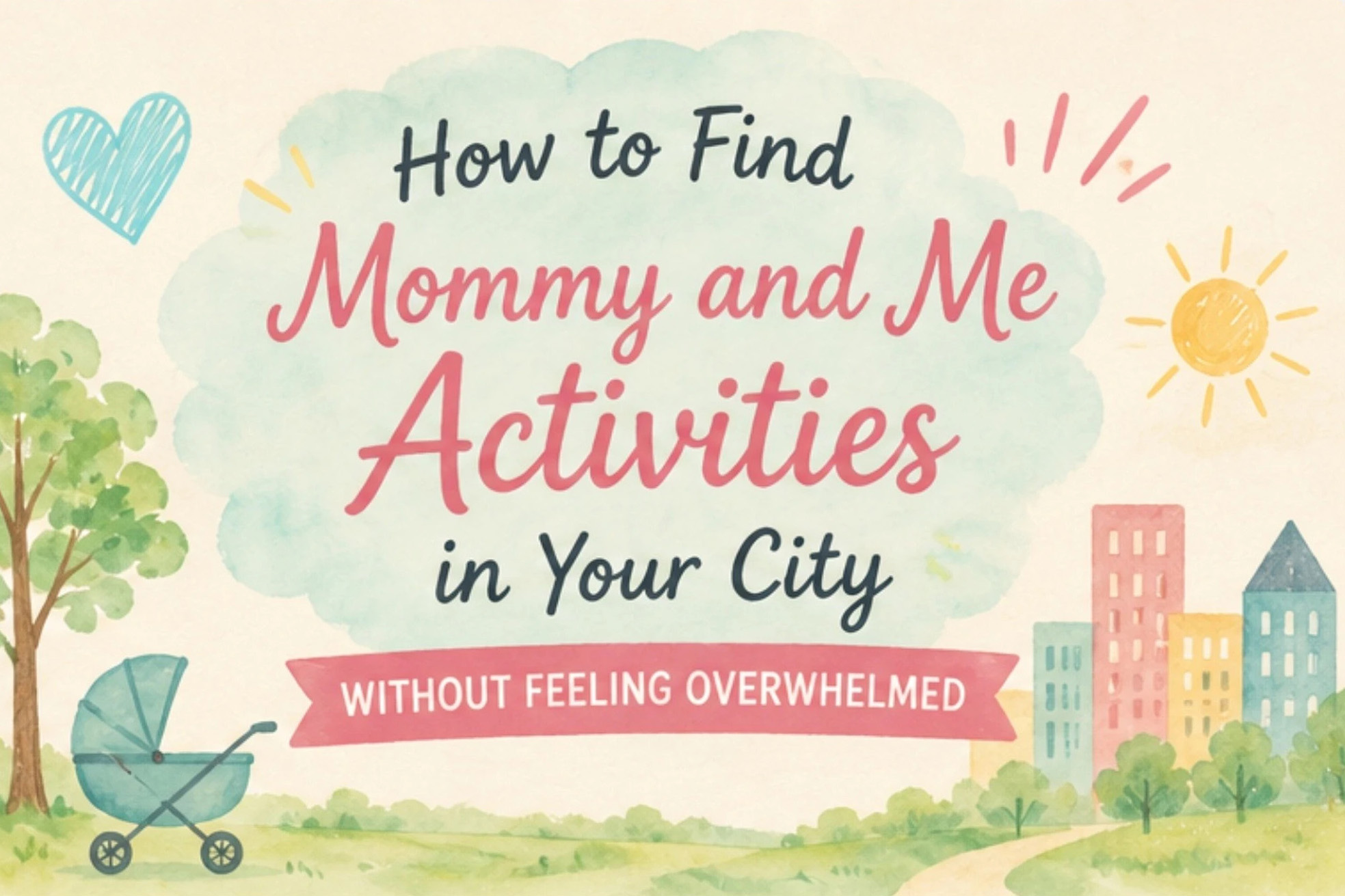
“How to Find Mommy and Me Activities in Your City Without Feeling Overwhelmed” is a collaborative post.
Finding things to do with a baby or toddler can sound simple until you actually try to do it.
You open Google. Then Facebook. Then maybe a local parenting group. Suddenly you have 27 tabs open, three classes that may or may not still exist, one music group with no schedule, and a gymnastics place that somehow only answers by voicemail.
Very relaxing. Exactly what every tired parent needs.
The good news is that finding a lovely Mommy and Me activity does not have to feel like planning a military operation. A little structure makes the whole search easier.
What are Mommy and Me classes?
“Mommy and Me” is a common name for parent-child classes where babies, toddlers, or preschoolers attend with a parent or caregiver.
Despite the name, they are not only for moms. Dads, grandparents, nannies, and other caregivers can usually join too. Depending on the class, you might find music, movement, sensory play, swimming, gymnastics, art, yoga, storytime, or gentle baby development activities.
The main idea is simple: your child gets to explore, play, and interact while you stay close by. Nobody is expecting your baby to master the violin or perform a perfect forward roll. Some days, success is simply arriving with both socks still on.
Why these classes can be helpful
For babies and toddlers, play is not “just play.” It is one of the main ways they learn.
Through simple group activities, children practice movement, listening, turn-taking, communication, and confidence. Even sitting next to another baby and staring suspiciously at their snack cup is a kind of early social experience.
For parents, the benefits are different but just as real. A regular class gives shape to the week. It gets everyone out of the house. It creates a reason to shower before noon, which can feel like a personal victory in early parenthood. And it can help you meet other parents who are in the same life stage.
That part matters. Parenting small children can be beautiful, funny, exhausting, lonely, and sticky. Sometimes all at once. Having a regular place where people understand nap schedules, teething, snack emergencies, and the emotional importance of the right cup can be surprisingly comforting.
There is also the “first germs” part of group activities. Of course nobody signs up thinking, “Wonderful, I hope we collect a new virus today.” But young children do gradually meet the wider microbial world. Good hygiene still matters, sick days should stay home, and handwashing is your friend. Still, group settings are often where children begin their long and dramatic relationship with shared toys, runny noses, and immune-system practice.
So how do you actually find a good class without losing your mind?
Start with word of mouth
Best for: real recommendations from people you already trust.
Watch out for: your circle may all know the same few classes, so the hidden gems slip past.
Word of mouth is still one of the best ways to find a good local activity.
Ask parents you already know. Ask your neighbors. Ask someone at the playground. Ask in your preschool chat, local baby group, or family WhatsApp thread. Parents tend to remember the classes that were actually worth leaving the house for.
The big advantage is trust. A recommendation from someone who knows your city, your child’s age, and maybe even your personality beats a random five-star review from 2018.
The catch is that word of mouth can keep you inside a bubble. Your friend group may all know the same two music classes, while a wonderful little art studio sits three neighborhoods away, quietly excellent and completely off your radar. Some of the best local activities are not the loudest ones online.
So it is a brilliant starting point. Just don’t make it your only one.
Use a dedicated class directory
Saves you time: everything is already grouped around parent-child activities, so there’s less to sort through.
Keep in mind: newer curated directories don’t cover every city yet.
A general search can work, but a directory built around one specific need saves you a lot of sorting.
For families in the United States, MommyAndMe.club is a growing directory focused on mommy and me classes and parent-child activities. It groups options by city, by activity type, and by the age range each class is meant for, so you can compare local music classes, movement programs, gymnastics, art, and baby activities all in one place.
The helpful part is the focus. You are not wading through birthday party venues, daycare listings, adult yoga studios, and abandoned Facebook pages just to find one toddler music group.
It is still an early-stage project, so not every city is fully covered yet. That is the trade-off with anything handpicked: it feels more curated and more trustworthy, but it grows more slowly than the giant automated platforms. If your city is already listed, though, it is a very easy place to begin.
Search local parenting communities
The payoff: honest, unfiltered details you won’t find on any official class page.
The cost: digging through old threads, mixed opinions, and the occasional comment-section drama.
Local parenting communities can be gold.
Reddit, Facebook groups, neighborhood forums, and community boards often have honest discussions about which classes are worth trying. People tell you things you will never find on a class website: whether parking is impossible, whether the instructor is magical with toddlers, or whether the “calm sensory class” is actually 14 toddlers running in circles with maracas.
Reddit is especially useful because many cities have active local subreddits, and some have parenting-specific threads where recommendations pile up.
The downside is time. You may need to dig through old comments, filter outdated advice, and sometimes post your own question. And whenever you ask the internet a parenting question, be prepared for at least one person to answer a completely different question with great confidence.
Still, communities show you real parent experiences, not polished marketing pages.
Check Google and Google Maps, but don’t stop there
Quick win: nearby options, hours, reviews, and distance, all in a couple of taps. The snag: some listings are outdated, dead, or not really what you’re after.
Google is the obvious place to search, and it is still useful.
Try things like “mommy and me classes near me,” “baby music class,” “toddler gymnastics,” “parent child swim class,” or “baby sensory class” plus your city name.
Google Maps helps you see what is nearby, check opening hours, read reviews, and figure out whether a class is realistically close enough to attend. A place may look perfect, but if it means a 45-minute drive during nap time, it is not perfect for your actual life.
The catch is that Google results get messy. Some listings are outdated. Some classes no longer run. Some providers are wonderful with children and terrible at websites. And some lovely small classes never rank well, because the teacher is busy teaching toddlers, not mastering SEO.
So use Google. Just treat it as one tool, not the final answer.
Try one class and ask other parents
Why it works: once you’re in the room, you meet parents who already know the local scene.
Just know: the first class may not be the fit, especially if your child is tired, hungry, or having one of those days.
At some point, the best research is simply going.
Pick a class that looks reasonably good and try it. Many providers offer a trial class, a drop-in option, or a first-visit discount. Even if it is not the one, you may meet parents who know about better options.
This is the old-fashioned method. Ask real people in a real room.
It works because parents at one local activity usually know about others. Someone at baby music may know the best toddler gymnastics class. Someone at storytime may know a great sensory playgroup. Someone at swimming may know which art class lets toddlers make a huge mess without anyone panicking.
The only real problem is that it costs social energy. If you are introverted, exhausted, or running on three hours of sleep and cold coffee, walking up to another parent can feel like a networking event with more diaper bags.
That is okay. You don’t need to become best friends on the spot. A simple “Have you tried any other classes around here?” is plenty.
How to choose without overthinking it
There is no perfect class.
Some children love music. Some want to climb everything. Some prefer art. Some mostly want snacks and emotional support. A class that is perfect for one child can be completely wrong for another, and that does not mean you chose badly.
When you compare options, think about your child’s age and stage, your nap and feeding times, the distance from home, the group size, and whether the class feels relaxed or tightly structured.
Then notice one more thing: whether you feel comfortable there too. You are part of the experience. If a class leaves you feeling judged, rushed, or unwelcome, it is probably not the right fit, even if the website looks beautiful.
Think of it as an experiment
Finding the right Mommy and Me class is not a life-changing decision you have to solve perfectly on the first try. It is more like a series of small experiments.
Try one. See how your child responds. Notice how you feel afterward. Did it make the day easier or harder? Did your child seem curious, calm, delighted, or completely done with humanity? All useful data.
You might find a class your child loves. You might find a weekly routine that gives your days more shape. You might meet another parent who becomes a friend. Or you might simply discover that your baby currently prefers chewing the registration form to participating in organized activities.
That counts too.
The goal is not a perfect childhood schedule. It is to find small, enjoyable ways to get out, connect, play, and make early parenthood feel a little less lonely.
And if everyone gets home with only one missing sock, honestly, that is a pretty successful outing.






Comments are closed.